Landing Remote Software Jobs from Egypt and MENA
A practical playbook for landing remote software jobs from Egypt and MENA: channels worth your time, contractor vs EOR, getting paid across borders, time zone math, and negotiation.

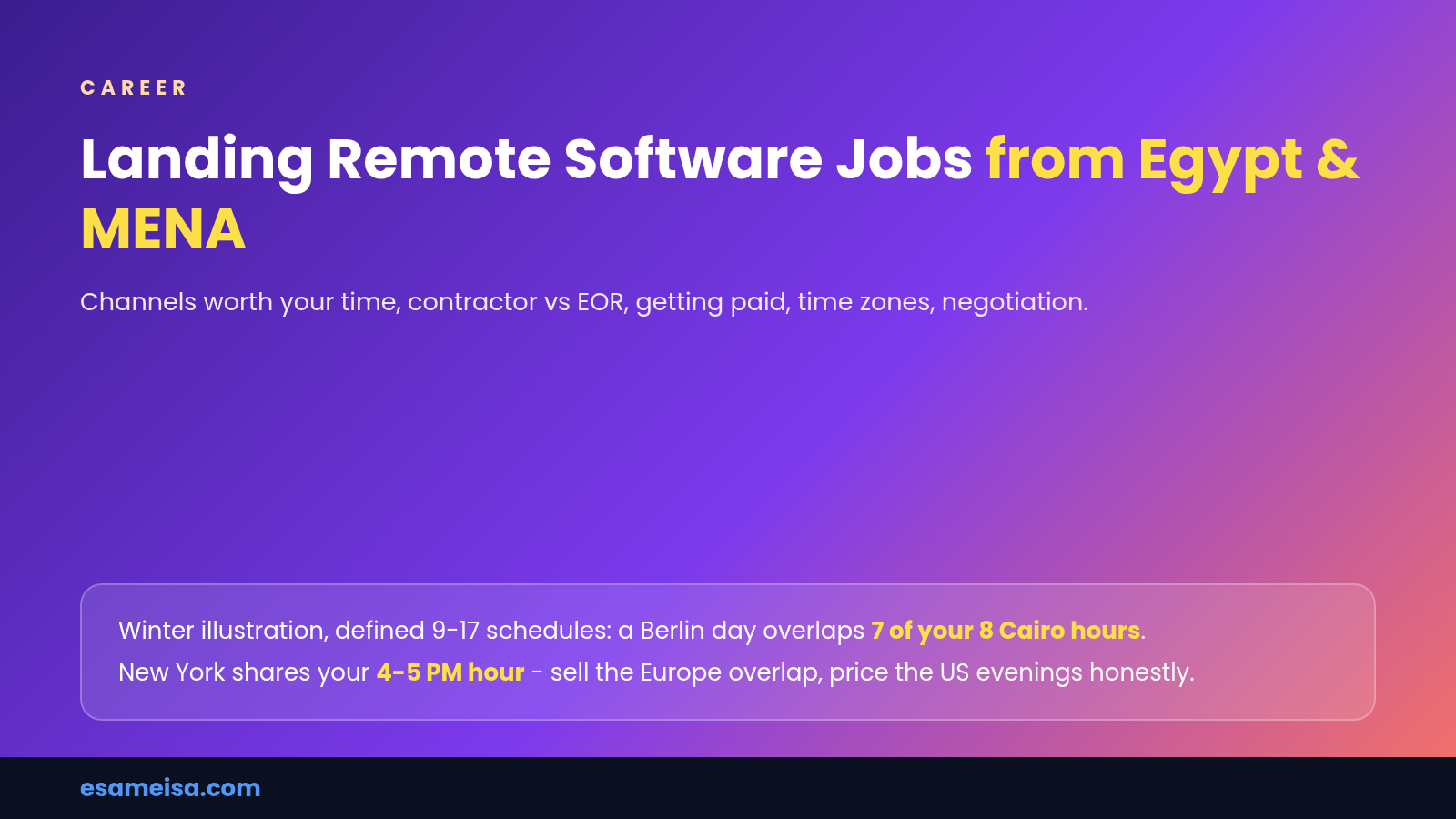
Table of contents
Remote jobs are a realistic path for engineers in Egypt and the wider MENA region, and this article is a practical playbook for pursuing them: which channels are worth your time, what your contract type really means, how money reaches you, and how to handle the time zone question before it handles you. One scoping note: salary comparisons need current data for your specific role, level and target market, so this article deliberately quotes no market rates - negotiating well does not require them.
Channels to investigate#
| Channel | What it's good for |
|---|---|
| The default hunting ground. Filter "Remote", set location to worldwide/Europe; recruiters message candidates here, so a complete profile matters | |
| We Work Remotely and Remote OK | Remote-first job boards, mostly companies that already know how to work distributed |
| Wuzzuf and Forasna | Egyptian and regional postings, including remote roles from Cairo, Gulf and European companies hiring locally |
| Vetted networks (Toptal, Arc, etc.) | A curated route to international clients; expect screening rounds before you see any of them |
| Communities and referrals | MENA tech communities, open-source work, conference talks - a public trail of work gets you introduced instead of filtered |
| Relocate-then-remote hybrid | Some European employers hire remote first with relocation optional later; a foot in the door either way |
Two habits beat volume: tailor the first three lines of every application to the actual posting, and keep a public trail of work (GitHub, articles, talks) that answers "can this person deliver remotely?" before the interview.
Contractor vs EOR: know what you're signing#
Two structures you'll run into in remote offers from abroad, and they are not interchangeable:
- Independent contractor. You are running an independent business: you invoice them, and what you owe in taxes and social insurance - and what protections, notice periods and benefits you do or don't have - depends on Egyptian law and on the exact contract you sign. Get qualified Egyptian advice on your specific setup before assuming either the obligations or the protections.
- Employer of Record (EOR). A third party (Deel, Remote, Oyster and similar) employs you locally on the company's behalf: local contract, payroll, statutory benefits under that arrangement. It is a more employee-like structure, but "more employee-like" is not a guarantee of stability - read the actual terms. The distinction and its trade-offs are well documented.
Before signing, ask explicitly: contractor or EOR? Who handles which local taxes and contributions? What happens on termination, and with what notice? And be aware that how a role is classified can be contested in some jurisdictions - a "contractor" working fixed hours under direct control may be treated as an employee under some laws, a risk for both sides. Get the answers in the contract, not on a call.
Getting paid into Egypt#
Common rails to investigate: direct SWIFT transfers to an Egyptian bank account, international payment platforms, or payroll through the EOR if you have one. Which platforms actually serve Egypt residents, with which currencies and withdrawal routes, changes often - verify each provider's current Egypt availability on its official site before you build your cash flow around it. This article makes no claim that any specific platform is available to you. What doesn't change:
- Agree the currency and who bears the FX conversion before the first invoice, in writing.
- Invoice on a fixed cadence with a paper trail; your bank may ask what incoming foreign transfers are for, and contracts plus invoices answer that in one email.
- Keep a buffer. International transfers and platform withdrawals can take days; a one-month cushion turns that from a crisis into a delay.
Time zones: sell the overlap, don't apologize for it#
Egypt is UTC+2 in winter and UTC+3 during daylight saving (in 2026, DST ran from April 24 to October 30, per timeanddate). As a winter-date illustration:
| Their winter morning | Cairo time (winter) |
|---|---|
| Berlin 9:00 (CET, UTC+1) | 10:00 |
| London 9:00 (GMT, UTC+0) | 11:00 |
| Dubai 9:00 (GST, UTC+4) | 7:00 |
| New York 9:00 (EST, UTC-5) | 16:00 |
These are offsets on specific dates, not year-round constants - DST transitions happen on different dates in different countries, and the weeks around a change are when recurring meetings silently drift. Worked example with defined schedules: a Berlin team working 9-17 (CET) against your Cairo 9-17 winter day overlaps from 10:00 to 17:00 your time - seven of your eight hours, and seven of theirs. Shift your day one hour later and the two workdays align completely. Against a New York team on the same 9-17, your shared window is 16:00-17:00 Cairo, so US collaboration largely lives in your evening. State your overlap proactively in interviews, with the actual schedules: "seven of my eight hours overlap yours - and I can align fully with a one-hour shift" is a concrete, checkable claim about a European team, and it reframes the time zone question from a risk into a feature. For US hours, decide consciously whether the evening trade is one you want.
Negotiation without quoting market rates#
Rates are out of scope for this article on purpose - a meaningful number depends on your role, level, target market and the date you look it up. What moves a negotiation regardless:
- Ask for the band first. "What's the budgeted range for this role?" is a normal question; make them name a number before you do.
- Price the whole package. A contractor arrangement and an EOR salary with benefits are not comparable line items - convert to total yearly value, including what each setup costs you in taxes, benefits and risk, before comparing.
- Negotiate the non-salary levers that cost them little: FX handling, equipment budget, learning budget, flexible hours inside the overlap window.
- Have a walk-away number based on your own alternatives, researched for your situation at the time you negotiate.
Common mistakes#
| Mistake | What it can cost |
|---|---|
| Applying everywhere with one generic CV | Silence; generic applications are the easiest to filter out |
| Signing without asking how taxes and benefits work in your setup | Obligations - or missing protections - you assumed away |
| Ignoring the FX question until the first invoice | Losing a percentage you never agreed to lose |
| Hiding your time zone instead of selling the overlap | They find out anyway, and now it's a trust problem |
| Treating a US-hours job as free money | The evening hours are a real, recurring cost; price the trade honestly |
| Resigning before the new arrangement is real | A signed PDF can still evaporate. Weigh notice obligations, conflicts between old and new commitments, and your financial cushion - with qualified advice if needed - instead of following any universal rule about when to quit |
Key takeaways#
Pick your channels deliberately and show visible remote-capable work. Know whether you're signing as an independent business or through an EOR, and get Egyptian-qualified advice on what that means for your taxes, benefits and protections. Settle currency, FX and invoicing cadence before the first invoice. Sell your time zone overlap with real schedules - a European workday can sit almost entirely inside yours - and negotiate the band, the package, and the levers that don't show up in a salary number.
References#
- Egypt DST 2026 dates: https://www.timeanddate.com/time/change/egypt
- EOR vs independent contractor: https://www.remofirst.com/post/eor-vs-independent-contractor
- We Work Remotely: https://weworkremotely.com - Remote OK: https://remoteok.com
- Wuzzuf: https://wuzzuf.net - Forasna: https://forasna.com
- Job hunting with AI in the loop: /en/blog/technical-interviews-for-engineers-who-use-ai
Hiring remotely for a backend role, or building a remote team in the region? See /en/services.