The Backend Engineer CV That Passes Screening
ATS screening isn't one universal scoring system. Two vendors - Lever and Greenhouse - publish how their products handle your application. What they actually say, plus 10 before/after bullet rewrites, a template, and a checklist.

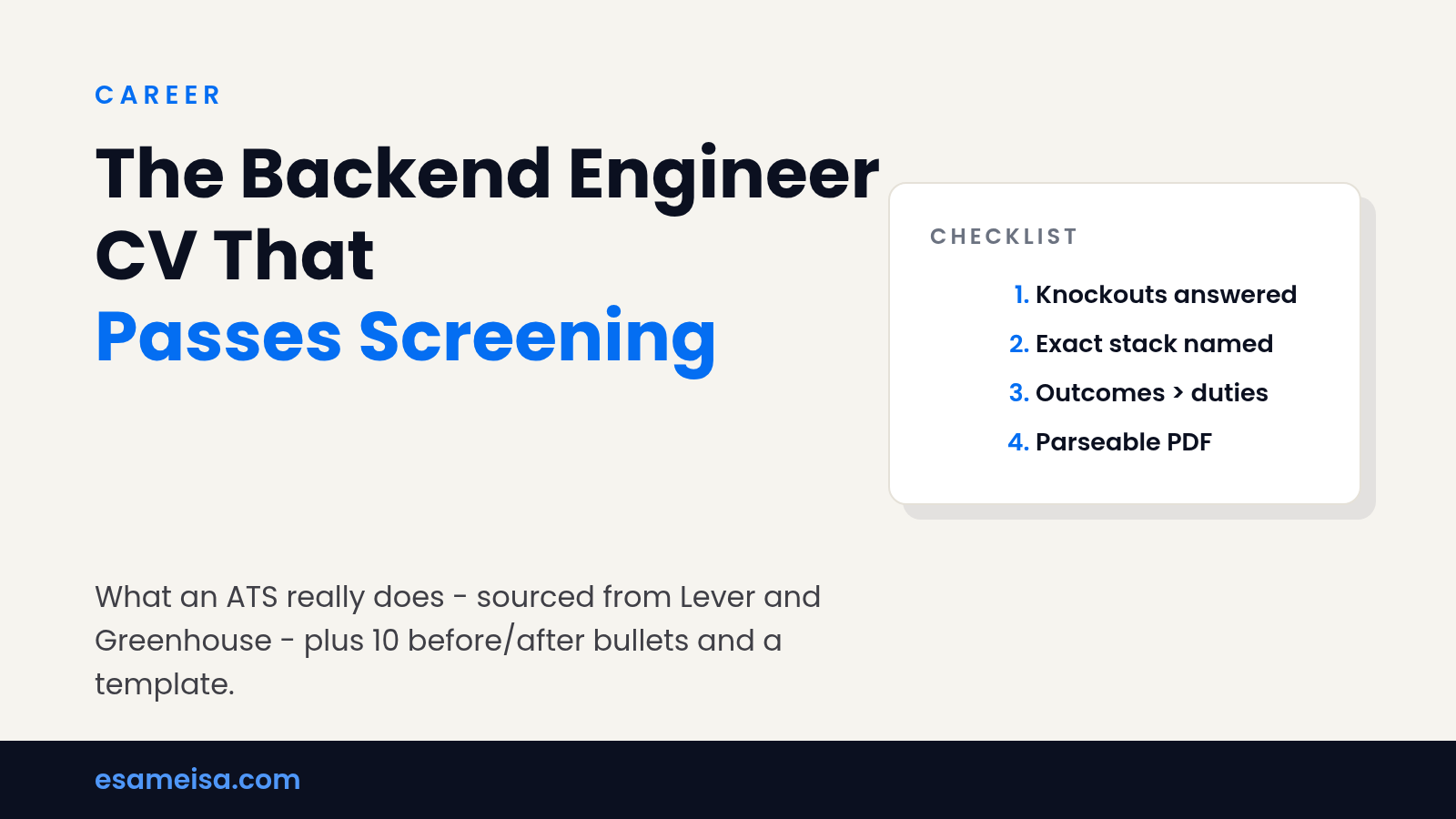
Table of contents
Your CV has one job in the first pass: get a human to keep reading. A lot of advice about applicant tracking systems is folklore. ATS screening isn't one universal scoring system - this article looks at what two ATS vendors, Lever and Greenhouse, publish about their own products, then gives you ten before/after bullet rewrites, a template, and a checklist aimed at backend roles.
What an ATS actually does (sourced)#
Two ATS vendors publish how their own products work - their descriptions below, not universal truths about every system on the market:
Lever (lever.co/blog/applicant-tracking-system-myths-debunked) lists the candidate beliefs it calls myths: that the ATS auto-rejects you by keyword match, and that "gaming the system" with hidden keywords works. Per Lever, knockout questions - set by recruiters and hiring managers, not the software - are what auto-eliminate applicants who miss bare-minimum criteria (years of experience, a required certification). Keyword-stuffing a CV does not move you up a recruiter's queue.
Greenhouse (my.greenhouse.com/blogs/what-really-happens-after-you-apply-for-a-job) describes the actual flow: your application lands in a queue on a recruiter's dashboard, recruiters review applications in the order received, and for in-demand roles auto-reject rules may exist - but "these filters are set and controlled directly by recruiters - not outsourced to a bot."
Myths vs facts#
| Myth | What the vendor says about its own product |
|---|---|
| "A robot reads my CV and auto-rejects it." | Rejection by automation happens mainly through recruiter-configured knockout questions and auto-reject rules on minimum criteria (Lever, Greenhouse). |
| "More keyword repetitions = higher rank." | Lever calls "gaming the system" a myth; recruiters search and filter, they don't get a keyword-density leaderboard. |
| "The ATS mangles my formatting so nothing matters." | Recruiters see your resume "exactly as you sent it" alongside parsed fields (Greenhouse). Parsing matters for searchability; a human still reads the original. |
| "Applying earlier doesn't matter." | Greenhouse describes recruiters reviewing in the order applications were sent - their described workflow, not guaranteed universal employer behavior. |
One claim worth handling carefully: you'll often read that "X% of Fortune 500 companies use an ATS" or that "75% of resumes are never seen by a human." These numbers circulate from ATS vendors and resume-scanning services (Jobscan and similar) and are marketing statistics - treat them as directional, not measured fact.
What this means for a backend CV#
- Knockout criteria are the documented automatic filter in these vendors' flows. If the posting requires "4+ years backend," your CV must make that answer findable in seconds - exact years, exact stack words from the posting, in plain text.
- A human does the real screen. Both vendors describe a person reviewing applications, so make the top third count: name, current role, years, stack, one proof-heavy bullet.
- Clean formatting helps search. Recruiters search their ATS ("postgres", "kubernetes", "payments"). If your CV says "worked on databases" instead of naming PostgreSQL, you don't exist for that search. Standard section headers (Experience, Skills, Education), one column, no text in images, no tables for layout - parsed fields feed those searches.
Ten bullets, before and after#
These are illustrative rewrites - the "after" versions show structure (action verb, named technology, quantified scope or outcome), not numbers you should copy. Use your real metrics; an invented number that collapses in an interview is worse than a vague truth.
| # | Before | After |
|---|---|---|
| 1 | Worked on backend services. | Built and maintained Laravel payment services processing 40k orders/day across 3 gateways. |
| 2 | Responsible for database optimization. | Added composite indexes and rewrote N+1 queries, cutting p95 order-list latency from 900ms to 120ms. |
| 3 | Helped with API development. | Designed and shipped a REST API consumed by 2 mobile apps; versioned without breaking clients. |
| 4 | Used Docker and AWS. | Containerized 6 services and moved deploys to GitHub Actions + ECS; deploy time down from 45 to 8 minutes. |
| 5 | Fixed bugs in production. | Reduced payment-webhook failure alerts from ~30/day to under 5 by making handlers idempotent. |
| 6 | Participated in code reviews. | Reviewed ~15 PRs/week; wrote the team's review checklist that caught a double-charge bug before release. |
| 7 | Worked with Redis. | Moved session storage and rate limiting to Redis, cutting database load 35% during flash sales. |
| 8 | Knowledge of testing. | Raised coverage on the billing module from 20% to 85%; zero billing regressions shipped since. |
| 9 | Team player, fast learner. | Onboarded 2 junior engineers; wrote the setup docs that cut ramp-up from 2 weeks to 3 days. |
| 10 | Did some DevOps. | Set up Prometheus + Grafana dashboards and alerts that caught a memory leak before the next peak. |
Notice what none of them do: no "responsible for", no "helped with", no soft-skill adjectives. Every bullet names the technology and one measurable scope or outcome.
The template#
NAME - Backend Engineer (PHP/Laravel, MySQL)
city | email | github | linkedin | years of experience

SUMMARY (2 lines max)
Backend engineer, X years, strongest in <stack>. One line of proof:
<biggest quantified outcome>.

EXPERIENCE
Role - Company, dates
- bullet: action verb + technology + scope/outcome (x3-5, best first)

SKILLS (searchable, grouped)
Languages: PHP, Python. Frameworks: Laravel, FastAPI.
Data: MySQL, PostgreSQL, Redis. Infra: Docker, AWS, GitHub Actions.

PROJECTS (if junior or career-switching)
Project name - one-line what/why - stack - link - one outcome bullet

EDUCATION
Degree, institution, year
Common mistakes#
| Mistake | Why it hurts |
|---|---|
| Two-column "designed" CV | Columns and text boxes parse unreliably; the recruiter's search may never see half your content. |
| Skill bars and percentage circles | "PHP: 80%" says nothing and can't be searched; name the skill and let bullets prove depth. |
| A summary paragraph of adjectives | "Passionate, detail-oriented team player" consumes the seconds your proof needed. |
| Duties instead of outcomes | "Responsible for the API" describes a job ad, not you; bullets should be past-tense accomplishments. |
| Sending the same CV everywhere | Knockout criteria and ATS searches use the posting's words; mirror the stack naming of each posting. |
| PDF exported from a design tool as images | If the text can't be selected, it can't be parsed; export text-based PDF. |
Checklist#
- Top third answers: who, current role, years, exact stack, one quantified bullet
- Stack words match the posting's naming (their "PostgreSQL", not your "relational databases")
- Every bullet: verb + technology + scope/outcome; zero "responsible for"
- One column, standard headers, selectable text, no images of text
- Links work: GitHub, LinkedIn, portfolio; pinned repos have READMEs
- Knockout questions in the posting answered visibly (years, work authorization, location/remote)
- Suggested length: one page for under ~8 years of experience, two at most after that - a common convention, not a hard rule
- File named
Firstname-Lastname-Backend-Engineer.pdf
Key takeaways#
In the workflows these two vendors document, the ATS is a queue and a search box; humans set the knockout rules and do the rejecting. Other systems may work differently - treat vendor descriptions as exactly that. The practical advice holds either way: plain formatting, exact stack vocabulary, and bullets that prove scope and outcomes.
References#
- Lever - 5 Applicant Tracking System Myths, Debunked: https://www.lever.co/blog/applicant-tracking-system-myths-debunked
- Greenhouse - What Really Happens After You Apply for a Job: https://my.greenhouse.com/blogs/what-really-happens-after-you-apply-for-a-job
- Jobscan (vendor perspective on ATS usage - treat stats as marketing claims): https://www.jobscan.co/applicant-tracking-systems
Want a second pair of eyes on your CV or a mock interview? See /en/hub#mentorship.