Hiring Your First Engineer as a Non-Technical Founder
You can't judge code - so judge evidence. Pick freelancer vs agency vs in-house, score a paid trial task on a rubric, and own every account from day one.

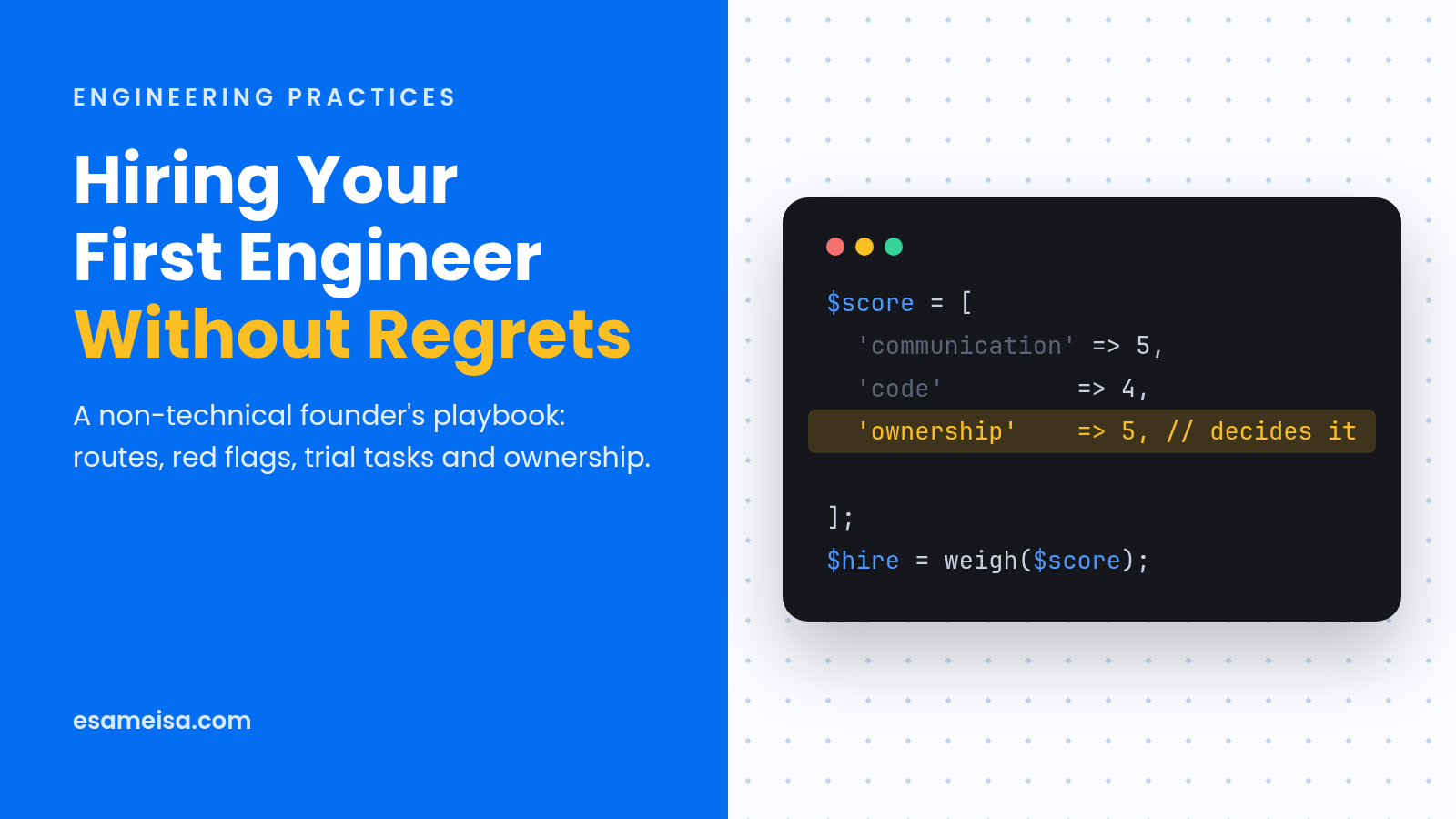
Table of contents
The expensive first decision#
You have an idea, some budget, and no way to judge the people who will build it. That information asymmetry is the real problem of a first engineering hire: every route - freelancer, agency, or employee - can produce a great product or an expensive rewrite, and from the outside the pitches look identical.
The fix is not learning to code. It is running a process that lets you compare candidates on evidence instead of confidence: a clear route decision, a paid trial task scored on a rubric, and ownership of every account from day one.
Your three routes (and option zero)#
Option zero is a technical co-founder. If someone in your network can fill that role, it beats every option below - YC's hiring guide calls personal networks the most effective source for a first hire by far. This article assumes that option is not available to you right now.
| Route | Best for | Watch out for | Commitment |
|---|---|---|---|
| Freelancer | A scoped prototype or MVP with clear deliverables | Continuity: one person, one point of failure | Hourly or fixed, weeks |
| Agency | A managed build - design, PM and dev bundled, with a deadline | Cost, handover quality, the "senior in the pitch, juniors on the work" swap | Fixed project price |
| First in-house engineer | A product that is the company and will iterate for years | You must manage technical decisions you cannot yet judge | Salary, usually plus equity |
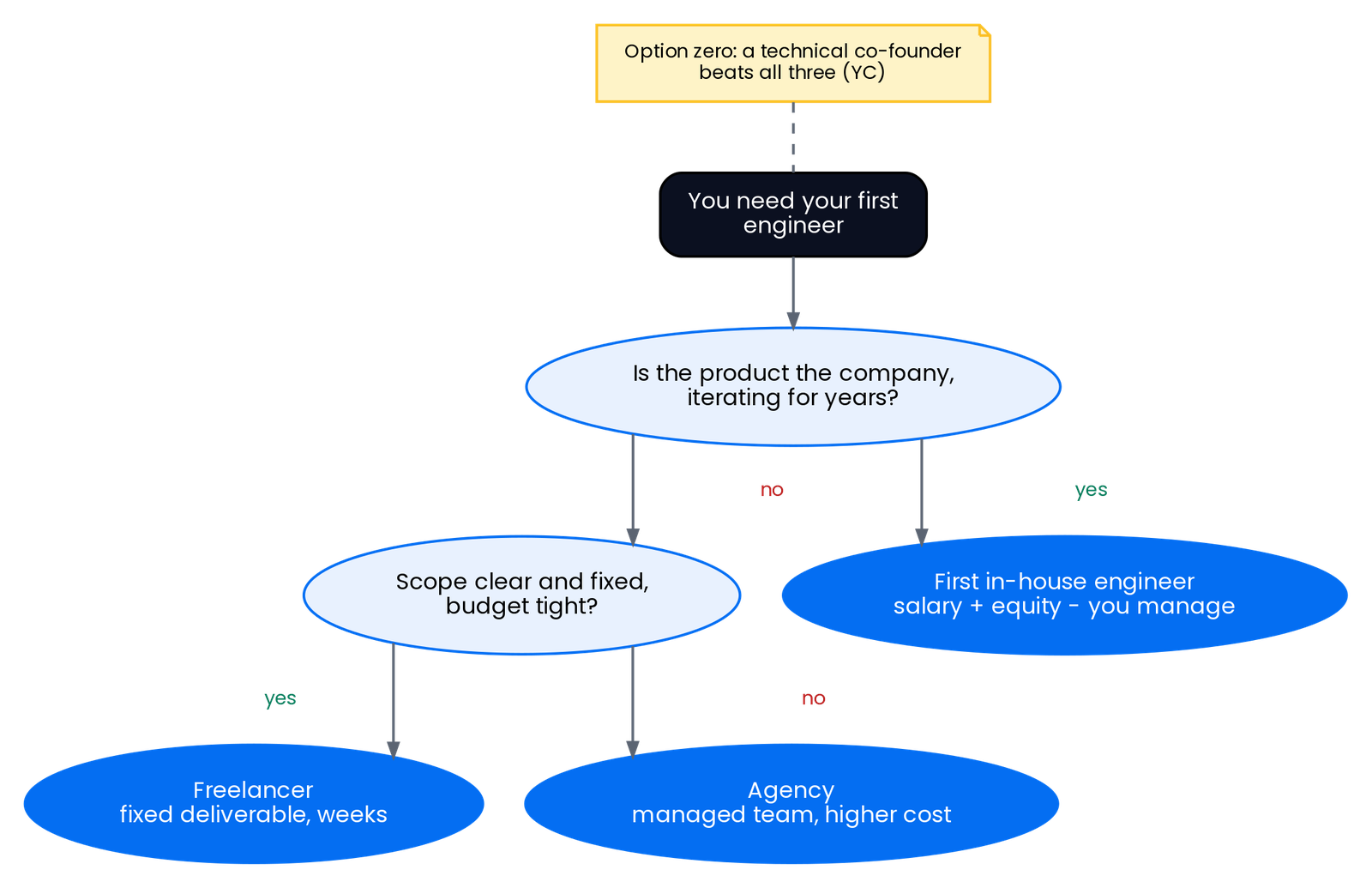
Two rules of thumb behind the flowchart:
- The more the product will change after launch, the worse fixed-scope contracts fit. A fixed-price agency quote on a product that will iterate for years buys you the first chapter, not the book.
- Nobody on any route is "yours" until the accounts are. A great freelancer with the repo under their personal account is a bigger risk than an average one with everything in yours.
How to evaluate when you can't read code#
You cannot judge code quality directly. You can absolutely judge behavior - and behavior predicts the engagement better than a portfolio does.
Red flags, on every route:
- They quote a price before asking questions about your business, your users, or what "done" means.
- They promise fixed price, fixed scope, and a fixed date, all up front.
- They suggest building under their own accounts or infrastructure "and transferring it later."
- They cannot show a single shipped product, public code, or a reference you can call.
- No mention of version control, tests, staging, or documentation in their process.
- (Agencies) The senior person sells, then disappears after the signature.
Green flags: they push back on your scope, propose a smaller first version, offer weekly demos, and insist - before you do - that everything lives in accounts you own.
The paid trial task#
The single best de-risking tool costs a few hundred dollars: a small, real, paid task.
- Scope it to roughly 4-10 hours. Always pay, whatever the outcome - asking for free work filters for candidates with no other options.
- Pick something real but off your critical path: a small feature, a spike on a risky integration, a one-page technical plan for your MVP.
- Give every finalist the same task, so scores are comparable.
- Score with a rubric, not a gut feeling. YC's advice for first hires is the same idea: write down your criteria in advance and mark each candidate against them.
| Criterion (weight) | A 1 looks like | A 5 looks like |
|---|---|---|
| Communication (25%) | Silent for days, then a delivery | Sets expectations, flags blockers early, demo at the end |
| Code & output quality (25%) | Does not run, no instructions | Runs as described, README, sensible structure |
| Questions & judgment (20%) | Builds exactly what you said, including the mistakes | Challenges the brief where it was wrong, documents assumptions |
| Estimation honesty (15%) | "Easy, two hours" - delivers late | Gives a range, explains uncertainty, hits it |
| Business understanding (15%) | Talks only about frameworks | Connects the task to users, cost, and your next milestone |
Score 1-5 per row, multiply by the weight, compare totals. A candidate who scores 5 on communication and 3 on code usually beats the reverse for a non-technical founder - you can get code reviewed; you cannot manage someone you cannot reach.
The ownership checklist#
Do this before anyone writes code. Each item is cheap on day one and expensive on day 100.
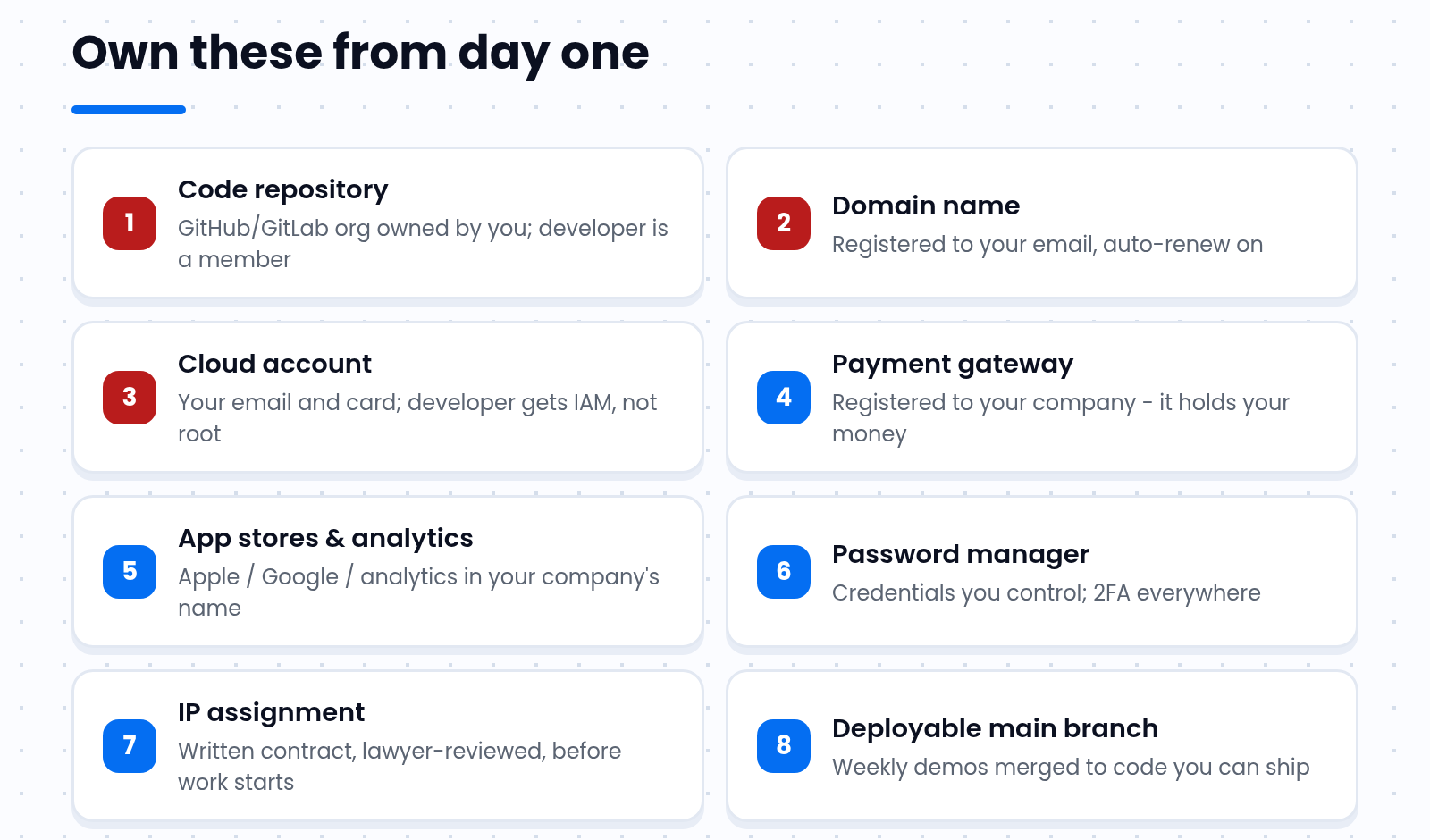
- The GitHub/GitLab organization is yours; the developer is a member or outside collaborator - never the other way around. Repos can be transferred later, but only by the owner.
- The domain is registered in your name, to your email, with auto-renew on.
- Cloud accounts (AWS, DigitalOcean, Vercel...) are created with your email and your card, billing alerts enabled; the developer gets scoped IAM access, not the root login.
- Payment gateway, app store, analytics, and error-tracking accounts are registered to your company - they hold your money and your data.
- A written contract with an IP assignment clause (work-for-hire where that exists). IP law varies by country; have a local lawyer review the template. Until this is signed, assume you do not own the code you are paying for.
- Credentials live in a password manager you control, with 2FA on every account.
- Weekly demos and code merged to a branch you can deploy. If your developer disappears tomorrow, you should lose a person, not the product.
Common mistakes#
| Mistake | Why it hurts | Do instead |
|---|---|---|
| Letting the developer own the repo or accounts | You can lose access to your own product and data | Own every account from day one (checklist above) |
| Choosing on the lowest quote | The cheapest build often becomes the most expensive rewrite | Score finalists on the same paid trial task |
| Large upfront payment | You lose all leverage the day it clears | Milestone payments tied to working demos |
| No contract, or no IP clause | You may legally not own what you paid for | Lawyer-reviewed agreement before work starts |
| Building a huge "v1" | Months of burn with zero user feedback | Ship the smallest useful version, then iterate |
Before you sign anything#
- Route chosen deliberately (freelancer / agency / in-house), not by whoever replied first
- At least two finalists completed the same paid trial task
- Scorecards filled in, and the winner wins on the rubric, not on charm
- Contract with IP assignment reviewed by a lawyer
- Every account in the ownership checklist created under your name
- First milestone defined small enough to demo within two weeks
Key takeaways#
- The route matters less than the process: same task, same rubric, evidence over confidence.
- Paying for trial tasks is the cheapest due diligence in the entire hiring process.
- You cannot judge code, but you can judge communication, estimation honesty, and questions asked - and those predict the engagement.
- Own the repo, the domain, the cloud account, the payment gateway, and the IP. Everything else is replaceable.
References#
- How to Hire Your First Engineer - Y Combinator (Harj Taggar)
- Transferring a repository - GitHub Docs
- The founder's guide to making your first few hires - First Round Review
Working through your first technical hire and want a second pair of eyes on your process? I mentor founders on exactly this - book a session.